The Myth of Laziness (And What's Really Going On)
Sunday, September 20, 2026
The Myth of Laziness (And What's Really Going On)
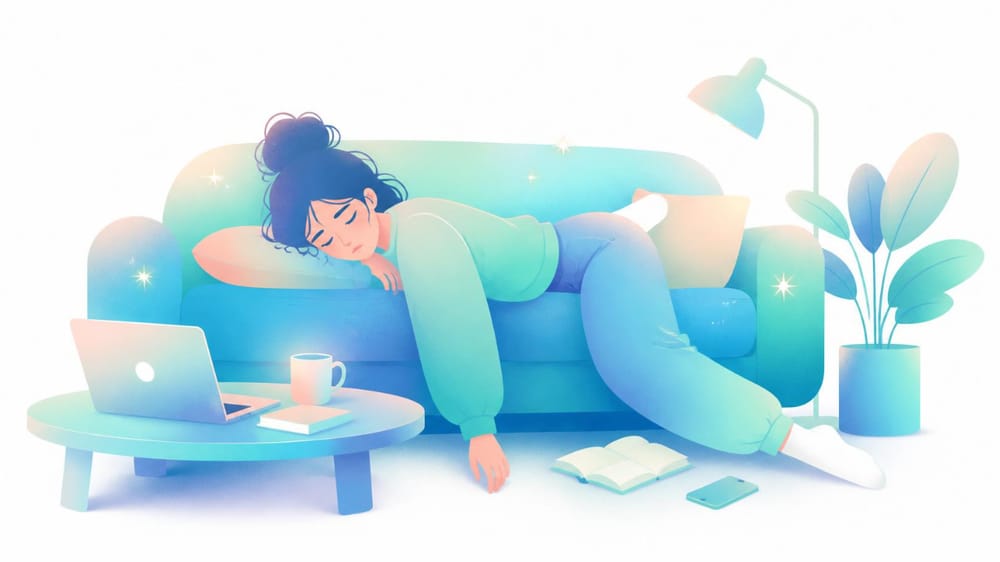
Ever sat on the couch avoiding one tiny task for three hours, feeling guilty the entire time? Yeah, us too.
And we are quick to label ourselves as lazy. But no one goes to the doctor and gets diagnosed with laziness. It's not a medical condition. It's not a personality disorder. It's a judgment, a cultural label we slap on ourselves and each other whenever productivity isn't happening the way we think it should.
So where did this idea even come from, what's actually happening in the brain when we avoid effort, and how do we stop treating ourselves like moral failures every time we need a nap? Let's get into it.
The Highlights
- The roots of laziness
- What's going on under the surface
- Laziness as judgment
- Ways to fix it (if it really needs fixing)
Where "Laziness" Came From
Laziness is an old idea wearing a new outfit. It started as acedia, a term sixth-century Christians used to describe the listlessness and disconnection monks experienced (it's also the root of our modern concept of boredom).
The Puritans picked it up and ran with it, starting to use the word "lazy" around 1540 and anchoring it in scripture: when Adam and Eve were cast out of Eden, God told them they'd have to work hard to provide for themselves. That got interpreted as hard work = moral goodness and salvation, while inactivity = sin. (Sloth is one of the seven deadly sins, after all.)
That Puritanical framework crossed the Atlantic, got tangled up in colonialism, and was later used to justify slavery. Then the Industrial Revolution cemented the idea that productivity equals economic survival and laziness got reframed as a social disease.
Fast forward to today: the word is more subtle, but it's still an undercurrent in how we talk to ourselves and judge other people. And it does real damage. Once you label a behavior "lazy," you stop being curious about what's actually causing it. You just shut the door on the conversation.
What's Actually Going On Underneath
Devon Price, a social psychologist and one of the leading researchers on this topic, points out that laziness isn't a diagnosis, but there's very often something real underneath it. ADHD, anxiety, depression, fear of failure, unrealistic expectations, fatigue, executive dysfunction, burnout — all of these can look like laziness from the outside while being something else entirely underneath.
There are also a couple of useful ways to think about effort itself:
The least-effort principle
Our brains are wired to conserve energy in case we need it later. A very sensible evolutionary strategy. But this theory has a hole in it: if we're built for least effort, why do millions of people voluntarily run marathons, take up CrossFit, or start businesses? The answer is payoff. We put in effort when it feels meaningful, connected to our identity, or rewarding, and a lot of that comes down to dopamine. When the reward hormone is low, effort doesn't happen. That's neurochemistry, not a character flaw.
Present bias
We're wired to prioritize immediate comfort over future benefit. That's why we skip the workout for the couch, scroll instead of learning something new, or avoid a hard conversation until it turns into a bigger problem.
Laziness as Judgment (Especially on the People Who Can Least Afford It)
When the "laziness" myth gets applied to a whole society, it tends to land hardest on the people most in need of compassion, not judgment. People experiencing poverty, homelessness, or living undocumented often pay the price of this (forgive the pun) “lazy” label.
It shows up in healthcare, too. Working as a dietitian with patients on dialysis, this comes up constantly — the assumption that someone "did this to themselves" by not doing all the right healthy behaviors. And yes, kidney disease is often preventable, but that take completely ignores a person's whole life: what they grew up with, what resources they had access to, what their options actually looked like 20 years ago. It takes a huge amount of energy just to manage a chronic illness. That's not laziness. That's survival mode. When most of your energy is going toward getting through the day, there's very little left over for anything else. Piling judgment on top of that doesn't create more motivation. It just steals more of the energy people don't have to spare.
So What Do We Do Instead?
First question: do you actually need to fix anything? Is something urgent actually falling apart, or are you just feeling guilty about resting? Those call for very different responses.
If something deeper is going on, therapy, behavioral tools, or medication can help. And if professional support isn't accessible, books, podcasts, and free resources are a real starting point too. The goal is simply not to stop at the label "lazy" and leave it there.
Instead, treat the feeling as a signal, not a personality trait, and start asking what's underneath it:
- Check the basics first. Sleep, food, water. Take the break. Grab the snack. Rehydrate.
- Look for the deeper needs. Connection, novelty, emotional satisfaction — what is your brain actually trying to solve for? It might be trying to avoid shame, reduce overwhelm, or protect you from failure.
- Make the payoff visible. Visualize how you'll feel after the workout, or picture yourself five years from now having stuck with something. Connecting a task to your values and identity makes the effort feel worth it.
- Make the future cost visible too. This is the adult version of the marshmallow test. A little reward now, or a lot more later. One study found people were more likely to choose future rewards after simply looking at age-progressed images of themselves. Financial educator Tiffany Aliche (the Budgetnista) does something similar, consulting her imagined "old lady self" before big financial decisions.
- Try body doubling. Working alongside someone else (in person, virtually, or even just at a coffee shop) improves focus and accountability, especially for people with ADHD. Focusmate is a solid tool if you want to try it virtually.
- Reframe rest. What looks like doing nothing might actually be your brain's default mode network doing quiet, essential work, including creative incubation. Rest isn't the opposite of productivity; sometimes it's part of the process.
The Quick Win
Next time you catch yourself reaching for "Why am I so lazy?" — try asking "What problem is my brain trying to solve right now?" instead.
Shame shuts us down. Curiosity opens the door to actually figuring out what's going on — and sometimes the most honest answer really is just: go take a nap.
Ready for More?
Take The Clarity Compass Quiz
In just 5 minutes, you'll:
- Discover your personal clarity block (so you'll finally understand why you feel the way you do).
- Get personalized reset moves - both creative and brain-based - to feel calmer and clearer today.
- See the path forward into your aligned self.
Have a Creative Week!
Episode Credits
The Everyday Creative is hosted by Evie Soape and Emily Soape. It is produced by Emily Soape.
Please drop us a comment or question at hello@theeverydaycreativecollective.com. You can also find us on Instagram @theeverydaycreativecollective and Pinterest.
Theme Music: “Living Life” by Scott Holmes Music. Available for use under the CC BY 3.0 license at Free Music Archive.
Break Background Music: "Alive In It" by Ketsa. Available for use under the CC BY 3.0 license at Free Music Archive
We always advocate for creation over consumption but also recognize that it may be necessary, at times, to purchase material things that support your creativity. So, sometimes, we recommend products and services related to creativity and living a creative life. We only recommend products and services that we would use and believe may provide value to you. The Everyday Creative Collective is community-supported (hence, no ads), and when you use our affiliate links (which include Amazon, among others), you help to support our collective goal, which is to bring this knowledge and support right back to you. A symbiotic relationship! This does not affect the price you pay or influence what we recommend

Hi, we're Evie & Emily
Co-founders of The Everyday Creative Collective
We believe that everyone is creative. Creativity can be used to enrich everyday life. Click here to learn more.